
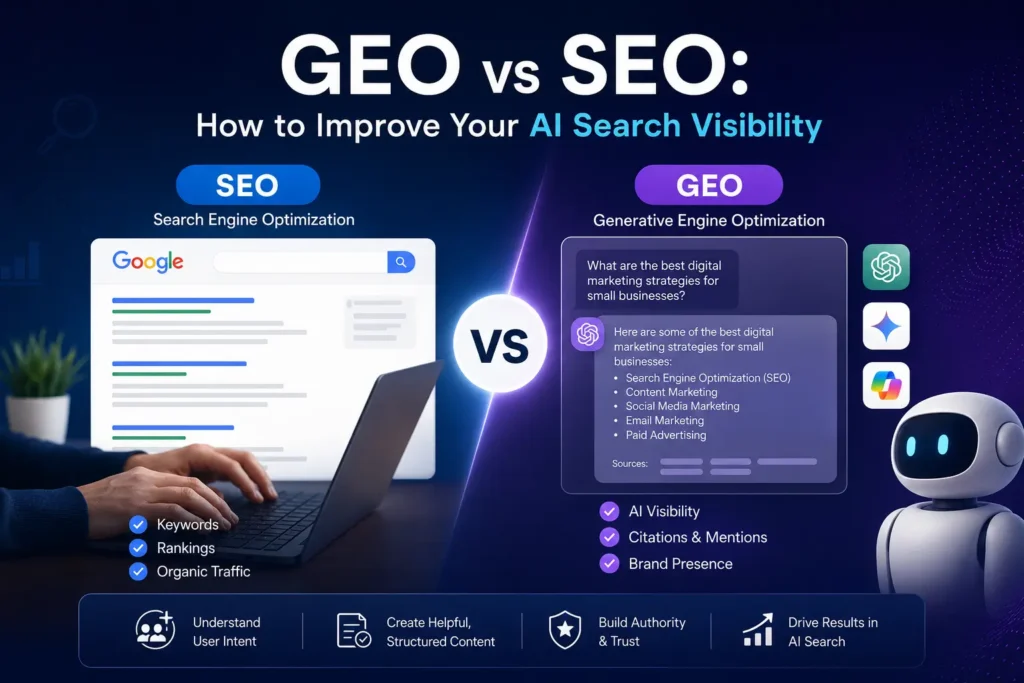
GEO vs SEO: Why Search Visibility Is Changing
GEO vs SEO – For years, digital marketing has revolved around one fundamental question: How can my website rank higher in Google search results?
That question still matters. But it is no longer the only search visibility question marketers need to ask.
People can now ask conversational questions directly to AI-powered search experiences and receive synthesized answers that may include citations, links, recommendations and information from multiple sources. ChatGPT, Google AI Overviews, Gemini and other AI search experiences are changing how people discover and evaluate information online.
That has created growing interest in GEO, or Generative Engine Optimization.
So, GEO vs SEO is not really a choice between two completely separate marketing disciplines. Traditional SEO remains important, while GEO focuses on making information easier for generative AI systems to retrieve, understand, attribute and use.
Google’s current guidance also makes this relationship clear: its guidance for generative AI features continues to emphasize established SEO fundamentals while encouraging useful, non-commodity content and appropriate text, image, video, local and shopping content.
The practical takeaway is simple:
SEO helps your content become discoverable in search. GEO focuses on improving the likelihood that your information is understood, referenced or surfaced within generative search experiences.
Neither approach guarantees visibility. AI search results can vary by query, source availability, context and time.
GEO vs SEO: What Is Generative Engine Optimization?
Generative Engine Optimization (GEO) is the practice of improving digital content and brand information so that generative AI systems can more effectively discover, understand and potentially reference it in their answers.
Traditional search engines generally present a list of results. Generative search systems can synthesize information from multiple sources into a conversational response.
For example, a traditional search might return:
- Website A
- Website B
- Website C
An AI search experience may instead provide a synthesized explanation and cite several sources supporting the response.
ChatGPT’s current web-search documentation explains that its search experience can use web sources and provide citations, while also noting that search placement is not guaranteed and that websites need to allow the relevant search crawler to access their content.
This creates a different optimization challenge.
Instead of asking only:
“How do I rank for this keyword?”
marketers increasingly need to ask:
“Is my brand or content understandable, credible and useful enough to be included when an AI system answers this question?”
That is the central idea behind AI search optimization and GEO.
GEO vs SEO: What Is the Difference?
The simplest way to understand GEO vs SEO is to compare the environments each approach is designed to support.
| SEO | GEO |
|---|---|
| Optimizes for search visibility | Optimizes for visibility in generative answers |
| Focuses heavily on search results | Focuses on AI-generated responses and citations |
| Targets search queries | Targets questions, topics and conversational prompts |
| Emphasizes crawling, indexing and relevance | Emphasizes retrieval, relevance, context and attribution |
| Builds organic search visibility | Builds potential AI-search visibility |
| Uses keywords naturally | Uses clear topics, entities and answer structures |
| Relies heavily on website content and links | Can also depend on broader sources and brand mentions |
| Measures rankings, impressions and organic traffic | Can measure mentions, citations, inclusion and share of AI visibility |
The distinction is useful, but it should not be exaggerated.
Google’s current documentation specifically states that SEO best practices remain relevant for appearing in its generative AI search features.
So the more accurate model is:
SEO → discoverability and search foundation
GEO → generative-search visibility layered on top of that foundation
This is why businesses should think about SEO for AI search, rather than abandoning SEO altogether.
GEO vs SEO: Why AI Search Visibility Matters
AI search changes an important part of the customer journey: how people discover information before they visit a website.
A potential customer might ask:
- What is the best CRM for a small business?
- Which digital marketing agency specializes in ecommerce?
- How does WhatsApp marketing work?
- What are the best alternatives to a particular software?
- What should a startup consider before investing in SEO?
Instead of clicking through several pages, the user may receive an initial synthesized answer.
That means your brand can potentially enter the customer’s consideration set before the customer reaches your website.
Current research on GEO also highlights an important limitation: visibility in generative systems is not a simple ranking position. AI responses can vary across prompts, runs and time, making one-off measurements unreliable.
This is why AI search visibility should be treated as a measurable but probabilistic marketing outcome—not a guaranteed ranking position.
GEO vs SEO: How Does Generative Engine Optimization Work?
There is no single universally accepted GEO formula.
Research into GEO is still developing, and a 2026 survey of the field found that terminology, metrics and evidence standards remain heterogeneous. It also describes generative visibility as a multi-stage process involving crawling, indexing, retrieval, reranking, context allocation, citation and user behavior.
That means marketers should avoid simplistic claims such as:
“Add these five GEO keywords and ChatGPT will recommend your business.”
There is no reliable formula like that.
Instead, a practical GEO strategy should focus on several fundamentals.
1. Create Clear, Useful Content
AI systems need information they can interpret.
Content should clearly explain:
- what your company does;
- who your product or service is for;
- what problems it solves;
- how it works;
- important differences between options;
- limitations and conditions;
- evidence supporting important claims.
This also happens to improve the experience for human readers.
2. Build Strong Topic and Entity Relationships
Search systems increasingly need to understand not just individual keywords but relationships between concepts.
For example, an article about “email marketing” may naturally cover:
- email automation;
- segmentation;
- lead nurturing;
- open rates;
- click-through rates;
- CRM;
- customer journeys;
- deliverability;
- personalization.
The goal isn’t to stuff these terms into the article.
The goal is to create a comprehensive explanation around the underlying subject.
3. Answer Specific Questions Directly
Generative search is conversational.
Instead of writing:
“Digital marketing has become an important component of modern business…”
answer the reader’s question:
“What is GEO?”
GEO, or Generative Engine Optimization, is the practice of improving content and brand information so generative AI systems can more effectively understand and potentially reference it in AI-generated answers.
Direct answers create clearer information units for both people and systems.
Your AEO/GEO framework recommends this approach: provide the direct answer first, then context, explanation, evidence, examples and relevant limitations.
GEO vs SEO: How to Improve AI Search Visibility
If you want to improve AI search visibility, start by improving the quality and structure of your existing content.
Use Question-Based Content
Identify the questions your customers actually ask.
For example, instead of publishing only:
“Digital Marketing Services”
build useful resources around questions such as:
- What does a digital marketing agency do?
- How much does digital marketing cost?
- Which digital marketing channel is best for local businesses?
- How long does SEO take?
- Is SEO or paid advertising better for a startup?
This creates content around real information needs.
Give Complete but Focused Answers
A page should answer its primary question thoroughly without becoming an unfocused encyclopedia.
Your content should explain:
What → Why → How → Example → Limitations → Next step
This structure helps readers understand the subject and creates clear answer units.
Use Evidence Where It Matters
AI systems may cite sources, but marketers should not assume that simply adding citations will make content authoritative.
Important claims should have credible supporting evidence.
Google’s current generative-AI guidance emphasizes helpful, original content and continues to point site owners toward established SEO fundamentals rather than a separate set of secret ranking tricks.
Does GEO Replace SEO? Understanding GEO vs SEO
No. GEO does not replace SEO.
This is one of the most important points in the GEO vs SEO discussion.
Your website still needs to be:
- crawlable;
- indexable where appropriate;
- technically sound;
- relevant to the user’s search;
- useful;
- accessible;
- well structured;
- supported by credible information.
Google’s 2026 documentation explicitly says SEO best practices continue to be relevant to generative AI features in Search.
The better approach is therefore:
SEO + high-quality content + strong brand/entity signals + answer-friendly information = stronger foundation for modern search visibility.
GEO should complement your existing organic search strategy rather than become an excuse to ignore technical SEO.
GEO vs AEO vs SEO: What’s the Difference?
These terms are often used interchangeably, but they describe related ideas.
SEO: Search Engine Optimization
SEO focuses on improving a website’s ability to appear in organic search results.
Typical areas include:
- technical SEO;
- content;
- search intent;
- internal linking;
- site architecture;
- authority and relevance.
AEO: Answer Engine Optimization
Answer Engine Optimization (AEO) focuses on providing direct, structured answers to questions.
It is particularly useful for:
- definitions;
- FAQs;
- how-to questions;
- comparisons;
- concise explanations.
GEO: Generative Engine Optimization
Generative Engine Optimization focuses more specifically on visibility within generative AI systems and AI-generated responses.
The three overlap considerably.
A useful way to visualize the relationship is:
SEO = search foundation
AEO = answer clarity
GEO = generative-search visibility
Rather than treating them as competing strategies, marketers can combine the principles where they serve the same reader need.
How to Build a GEO Strategy for Better AI Search Visibility
A practical GEO strategy doesn’t need to begin with expensive software.
Start with your existing content.
Step 1: Identify Your Important Customer Questions
List the questions customers ask before:
- discovering your company;
- comparing solutions;
- contacting sales;
- making a purchase;
- renewing or upgrading.
Prioritize questions that influence commercial decisions.
Step 2: Audit Existing Content
Look for pages that are:
- outdated;
- vague;
- overly promotional;
- missing important definitions;
- poorly structured;
- unsupported by evidence;
- difficult to scan.
Improve those pages before creating dozens of new ones.
Step 3: Strengthen Your Entity Information
Make your business information consistent across relevant properties.
Clearly communicate:
- business name;
- products/services;
- locations;
- expertise;
- industries served;
- authors;
- relevant credentials;
- contact information.
Entity clarity is important because systems need to understand what an organization is and how it relates to the subject being discussed.
Step 4: Build Topical Authority
Don’t publish 50 shallow articles targeting slightly different keywords.
Build a useful topic cluster.
For example:
Pillar: Digital Marketing Strategy
Supporting resources:
- SEO strategy
- GEO strategy
- AI search
- Content marketing
- Social media marketing
- WhatsApp marketing
- Email marketing
- Conversion optimization
Each article should solve a distinct reader problem.
Step 5: Earn Credible Third-Party Recognition
A brand’s own website isn’t the only source of information available to search and AI systems.
Independent sources, specialist publications, industry organizations, reviews and other credible references can provide additional context.
Research into GEO has found differences between AI search systems in source selection and domain diversity, reinforcing the need to avoid relying on a single platform or visibility tactic.
The objective should not be to manufacture mentions.
It should be to build genuine authority around the brand and subject.
GEO vs SEO: How to Measure AI Search Visibility
Traditional SEO metrics aren’t enough to understand every aspect of AI search.
You can monitor:
- brand mentions in AI responses;
- citation frequency;
- cited URLs;
- competitor mentions;
- questions where your brand appears;
- questions where competitors appear;
- sentiment or framing;
- source diversity;
- organic search performance;
- qualified referral traffic;
- branded search demand.
But measurement needs to be repeated.
Research published in 2026 argues that one-off AI-search measurements can be misleading because responses vary across prompts, runs and time.
A practical measurement process might look like this:
1. Create a fixed set of important customer questions.
2. Test them periodically across relevant AI search systems.
3. Record whether your brand appears.
4. Record which sources are cited.
5. Compare your visibility with relevant competitors.
6. Repeat the test instead of relying on one snapshot.
This produces a much more useful picture of your AI search visibility.
GEO vs SEO: Common GEO Mistakes to Avoid
Mistake 1: Treating GEO Like a Keyword Hack
There is no magic list of “GEO keywords.”
Generative systems are not simply matching a keyword and returning the page with the highest repetition.
Focus on relevance, clarity, evidence and usefulness.
Mistake 2: Abandoning Traditional SEO
This is perhaps the biggest strategic mistake.
Google’s own current guidance indicates that existing SEO practices remain relevant to its generative search experiences.
Mistake 3: Creating Large Amounts of Generic AI Content
Using AI to produce hundreds of similar articles doesn’t automatically create authority.
Google has also clarified that its spam policies apply to generative AI responses in Search.
The goal should be useful content—not content volume for its own sake.
Mistake 4: Optimizing for One AI Platform
AI systems differ.
Research has found differences in source selection, freshness, domain diversity and sensitivity to query phrasing across generative search systems.
Build a durable content and authority foundation instead of trying to reverse-engineer one platform.
Mistake 5: Assuming Visibility Equals Business Results
Being mentioned by an AI system is not automatically a conversion.
Track the complete journey:
AI visibility → website visit → engagement → enquiry → conversion
Where possible, connect AI-search activity with meaningful business outcomes.
The Future of GEO vs SEO
The GEO vs SEO debate will probably become less useful over time.
Why?
Because search itself is becoming more integrated.
Traditional search results, AI-generated answers, conversational interfaces, video, images, shopping results and other discovery experiences increasingly exist within the same digital ecosystem.
Google’s 2026 Search documentation now includes dedicated guidance for generative AI features and emphasizes that existing SEO principles remain relevant.
At the same time, ChatGPT search demonstrates how users can ask questions conversationally and receive answers supported by web sources.
The winning strategy is therefore unlikely to be:
SEO or GEO.
It is more likely to be:
SEO + useful content + strong entities + credible sources + clear answers + consistent brand information.
Final Takeaway: SEO and GEO Should Work Together
The biggest mistake marketers can make with GEO vs SEO is assuming they have to choose one.
SEO remains the foundation for organic discoverability.
GEO adds another consideration: Can AI-powered search systems understand, trust and potentially reference the information your business publishes?
The answer isn’t to stuff content with keywords or chase every new AI-search tactic.
Instead:
- Understand your customers’ questions.
- Create genuinely useful answers.
- Make your content easy to understand and navigate.
- Support important claims with credible evidence.
- Build clear brand and entity information.
- Strengthen relevant third-party authority.
- Continue investing in technical and traditional SEO.
- Measure AI search visibility repeatedly.
- Track business outcomes, not mentions alone.
- Update the strategy as search systems evolve.
GEO is not the death of SEO. It is part of the broader shift from ranking pages to being discoverable, understandable and useful across modern search experiences.
Frequently Asked Questions About GEO vs SEO
What is the difference between GEO and SEO?
SEO focuses on improving organic search visibility, while GEO (Generative Engine Optimization) focuses on improving the likelihood that content or brand information is understood and potentially referenced within generative AI search experiences.
Does GEO replace SEO?
No. GEO should complement SEO. Google currently states that established SEO best practices remain relevant to its generative AI search features.
How can I improve my AI search visibility?
Start by creating useful, well-structured content that directly answers customer questions. Strengthen technical SEO, entity clarity, evidence, internal linking and credible external references, then repeatedly monitor how your brand appears in relevant AI-search queries.
Is GEO a ranking factor?
There is no single universally established “GEO ranking factor.” Generative search involves multiple stages and different systems, and research indicates that AI visibility can vary across queries and repeated runs.
What is AEO vs GEO?
AEO generally focuses on providing clear answers to questions, while GEO focuses more broadly on visibility within generative AI systems. They overlap and can be used together with traditional SEO.
Can small businesses benefit from GEO?
Yes, but they should avoid treating GEO as a shortcut. Small businesses can focus on clearly explaining their expertise, services, locations, customer problems, evidence and differentiators while maintaining a strong SEO foundation.